
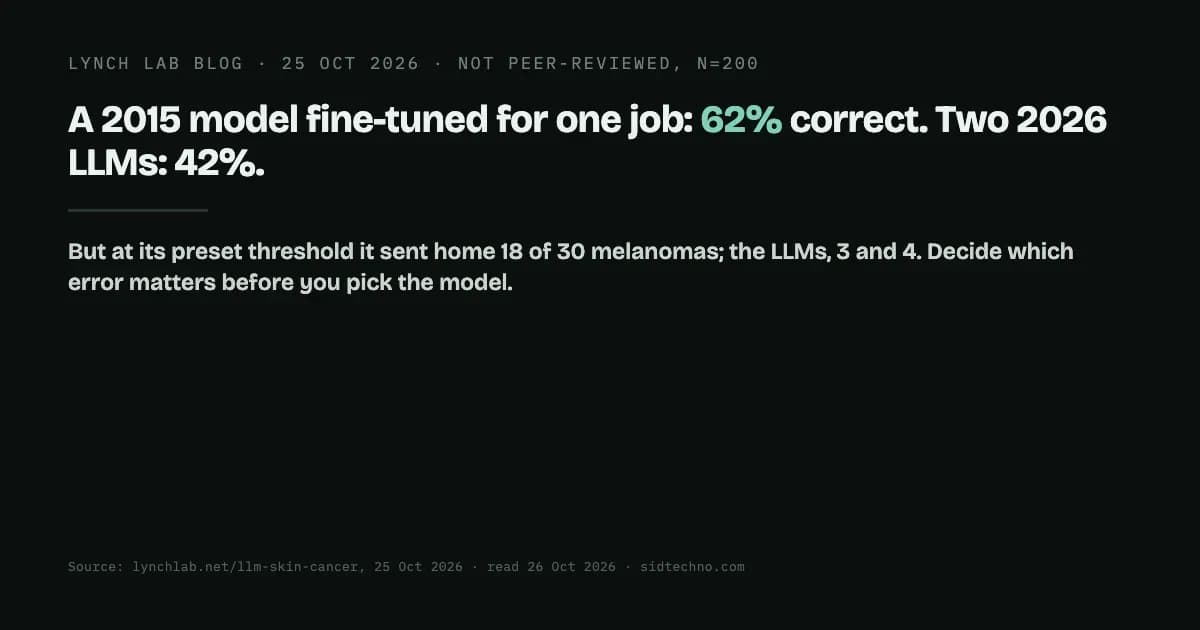
On 25 October 2026 Dr Magnus Lynch, a consultant dermatologist, published a test on his lab's blog: two of what he calls the most capable AI models available in October 2026, against a small image classifier first published by Google in 2015. On one narrow task, the old model won. This post is not about medicine, and nothing here is advice about skin cancer. It is about a question every business buying AI should ask: what is the right size of model for the job?
The test, briefly
Lynch gave 200 skin lesions, each confirmed by biopsy, to GPT-6 Astra, Claude Fable 5.1 and Inception v3, a convolutional neural network (CNN) from 2015 that he fine-tuned on public dermatology images. Each model had to pick the right diagnosis out of six. In his results table:
- Inception v3 (fine-tuned): 125 of 200 correct (62%)
- GPT-6 Astra: 84 of 200 (42%)
- Claude Fable 5.1: 85 of 200 (42%)
His summary: "A ten-year-old network, fine-tuned for about twenty minutes, beat both of them at recognising skin cancer."
What the test is, and isn't
This is a blog post by one specialist, not a peer-reviewed study, and the sample is 200 cases. Lynch lists the limits himself:
- Small numbers. "Two hundred lesions are enough to show the pattern but not to rank close results", and each LLM case was run once.
- Hard cases. Every lesion had been biopsied, including the harmless ones, so these are the cases that worried a clinician.
- Possible contamination. The dataset has been public since 2025, so the LLMs may have seen it in training. As he notes, that would have helped them.
- Not state of the art. "Inception v3 is a baseline." In his words, current systems use newer architectures trained on more data, and "the regulated products built on them perform considerably better".
So the finding is narrow: on this one well-defined image classification task, a small fine-tuned model did better than two general-purpose ones. It says nothing about what large language models can do in general.
The number that changes the story
Accuracy is only half of Lynch's table. He also counted which lesions each model would send home without treatment, and the old model, at its preset threshold, sent home 18 of the 30 melanomas. The two LLMs sent home 3 and 4. With the CNN's threshold matched to the LLMs, his table shows 2 or 1.
That is the real engineering lesson. The same model can look excellent or dangerous depending on where its cut-off is set. "Which model is most accurate?" was the wrong first question. The right one was "which mistake is expensive, and what threshold keeps it rare?"
What this means for picking a model
- Start from the task, not the model. A narrow, well-defined classification job, with a fixed set of answers and plenty of labelled examples, is exactly where a small specialised model can beat a large general one.
- Decide which error costs more before you compare anything. A missed problem and a false alarm rarely cost the same. Measure the one that matters, not just overall accuracy.
- Treat the threshold as part of the product. It should be set on purpose, written down and tested, not left at a default.
- Weigh size against running cost. Lynch notes his model is small enough to run in a phone browser. A small model is often cheaper and faster to run, and easier to test end to end.
- Test on your own hard cases. A vendor's headline benchmark is not your data. Two hundred of your own difficult examples will tell you more.
The biggest model is not automatically the right tool. Sometimes the right tool is a small one, trained for one job, with a threshold someone chose deliberately.
Source: Dr Magnus Lynch, Lynch Lab, "A 10-year-old CNN outperforms frontier LLMs for skin cancer diagnosis" (25 October 2026, read 26 October 2026). A lab blog post, not peer-reviewed. Nothing in this article is medical advice.