
On 19 October 2026 Cloudflare published seven months of real numbers from the AI code reviewer it runs on its own pull requests. The headline is a 68% cut in cost per review. The more useful part is how the bill got high in the first place, because it happened while the number most teams watch was getting better.
A near-perfect cache rate, and a bill that doubled
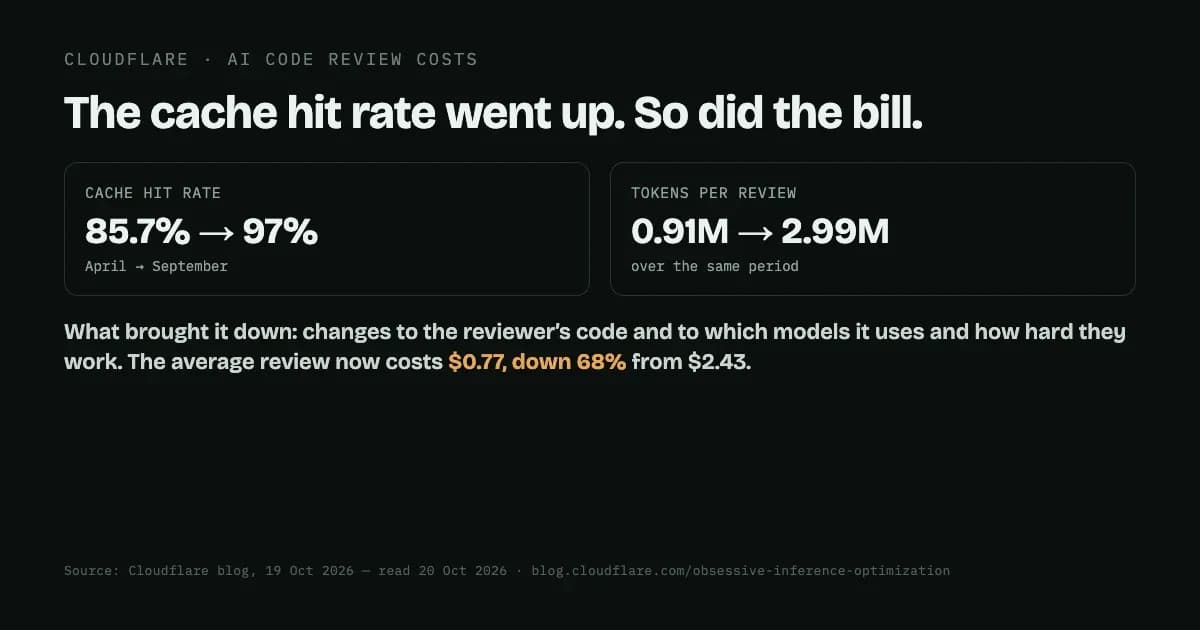
Cloudflare's reviewer sends a lot of the same context to the model again and again, so prompt caching matters. The cache hit rate went up all year. In Cloudflare's words: "The cache hit rate also increased, going from 85.7% in April to 97% by September, while the number of tokens per review more than tripled, from 0.91 million to 2.99 million. A high hit rate on three times as many tokens still costs a lot more, even with the low cache read cost."
Over the same period, the cost of an average review went from $1.19 in April to about $2.46 by the end of August. Cloudflare says there were no significant architectural changes. The reviewer simply did more: more context, more calls, more tokens.
Part of the rise was a deliberate choice. "At the start of August we moved every reviewer onto Anthropic models, which raised the cost per job from $1.38 to $2.03", a move Cloudflare made because "during our evals, Anthropic models performed better on this specific workload than other models."
What brought it down
From mid-September, Cloudflare went after where the tokens were going. The result: "With code quality at high effort, the average review now costs just $0.77, down 68% from the $2.43 it averaged over our two most expensive weeks before we started." Reviews also got faster. "the median review now takes just 1m 32s instead of the 4m 09s it took before."
Cloudflare splits the credit: "About 40% of the savings came from changes and optimizations to the reviewer's code, and the rest from experimenting with which models we use and how much effort they put in." On the code side, "Since the start of September cache reads per review are down 82%, cache writes down 54%, and output down 67%."
The model experiment is the clearest example. "On October 3, we split every Sonnet reviewer 50/50 between Sonnet 5 and Sonnet 5.5. After two and a half days, Sonnet 5.5 was 62% cheaper per run for code quality, 58% for performance and 47% for security. The two models cost the same per token, so all of that comes from using fewer tokens." Same price per token, very different price per job.
Cheaper didn't mean worse, everywhere
Cloudflare checked whether the cheaper reviewer was still finding real problems. For code quality at high effort, it concluded that what disappeared was mostly noise and inflated severity, and that it "still finds about as many real problems as before." But not every setting held up: "Medium effort did lose real findings." A cost cut has to be measured against what the system is for, or it can quietly become a quality cut.
Questions to ask about your own AI bill
- Is the cost per job going up, or just the volume? A rising bill can mean more use, or it can mean every job got heavier. They need different fixes.
- How many tokens does one job send, and is that number growing? A good cache rate on a growing context is still a growing bill.
- Have you compared models on cost per job, not price per token? Cloudflare's two models had the same token price and very different costs per run.
- When you cut cost, what do you measure to make sure quality held? Cloudflare checked whether people acted on the findings, and found one setting that did lose real ones.
The lesson in Cloudflare's numbers is that the cache rate was never the dial that mattered. What mattered was how much each job sent, and what each job was worth.
Source: Cloudflare, "Cutting our inference bill by 68% by being obsessive about optimization" (published 19 October 2026, read 20 October 2026).