
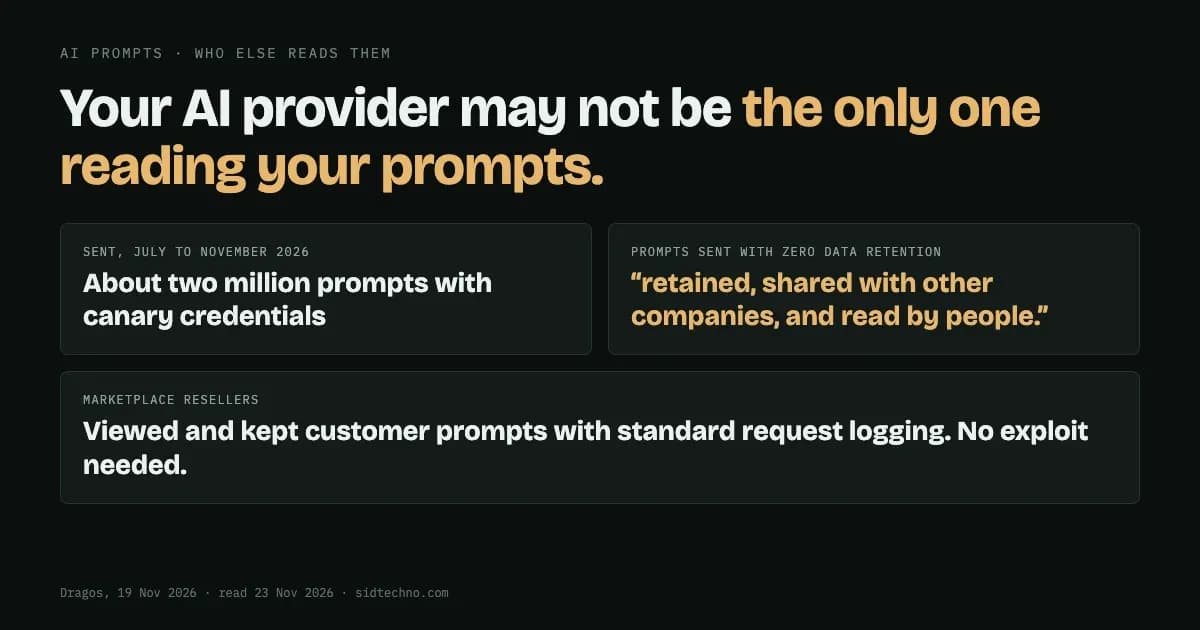
On 19 November 2026, Dragos published research by HD Moore, its Chief Research Officer, under the headline “Three breaches, endless leaks: Your AI supply chain needs canaries”. The method is simple to describe:
“Over a five-month period from July through November 2026, we submitted approximately two million prompts containing unique URLs and canary token credentials to widely used AI services and monitored what happened after inference.”
A canary, in the post’s own definition: “A canary token is a secret that only exists in one place – if anyone ever uses it, you know that place has been exposed.” So every token that was later used marks a prompt that someone other than the intended service saw. The post also says: “Tokens started firing within days, and the tokens from July are still firing today.” That was written on 19 November, so this is research that was still running when it was published.
If you send prompts to an AI model, directly, through a router, or through a tool or agent that does it for you, the useful question here isn’t whether AI services are safe. It’s who actually handles your prompt between you and the model. The post reports three kinds of finding, and they are different enough that it’s worth keeping them apart.
1. Providers whose data was exposed
The summary at the top of the post is hedged, and the hedge belongs in any retelling:
“We observed activity indicating that data from at least three AI providers was exposed.”
The detailed section describes bait AWS keys from the prompts being tested and used against the researchers’ empty, fully logged accounts. One detail shows where the copying happened in one case:
“Some of the stolen keys came from requests that the provider rejected before a model ever ran – this tells us that the attacker was copying requests at the provider’s front door, and not somewhere deeper in the inference stack.”
Some of the requests involved in two of these incidents were marked Zero Data Retention (ZDR), which leads to one of the post’s plainest lines: “A privacy flag doesn’t help when the attacker is already inside.” The post does not name these providers.
2. Marketplace resellers reading prompts, with no exploit needed
This is the finding that should change how people think about cheap inference. Some AI routers are open marketplaces where several sellers offer the same model, and the post describes requests going to the lowest price. The post’s summary of what happened:
“Multiple resellers operating through an AI inference marketplace were able to view and retain customer prompts using standard logging capabilities, without exploiting a vulnerability or bypassing platform controls.”
And in the detailed section: “The marketplace sellers that we caught only had to list a model at the lowest price, enable request logging, and wait.” Getting the prompts took no hacking. The data reached whoever was serving the request, through the platform working as designed. The post adds that the leak was specific to particular sellers:
“Prompts for the same model that went through a different seller were never touched, which tells us that the leak follows the seller and not the marketplace as a whole.”
The general point behind it comes from the section on how routers work: “There is risk in this process – every hop can see the entire prompt and response.” The post also describes a router that was forwarding some of its traffic to the marketplace without saying so.
3. Privacy settings that didn’t hold
“We observed multiple cases in which providers appeared not to honor customer privacy settings or published policies.”
The clearest examples in the post involve secret URLs from prompts being fetched by companies that were not supposed to see the prompts, including for requests that asked for no data collection or ZDR. The most striking single case is a secret link from a prompt that later turned up in a company chat in China:
“Our disclosure to this provider only included the first eight characters of that link, so whoever shared it was reading from a stored copy of the full prompt, more than three weeks after the request was sent to a U.S.-based provider with the ZDR flag.”
The section closes:
“Zero Data Retention is supposed to mean something. In practice, these prompts were retained, shared with other companies, and read by people.”
This finding isn’t limited to marketplaces. The post also says: “The large U.S. providers have their own issues.” Its examples include secret URLs being crawled long after a single request. The providers aren’t named here either.
What this does and doesn’t show
- It shows that a privacy setting is a request, not a guarantee. In the post’s words: “Keep in mind that a privacy flag only binds the first hop, and that AI agents will happily send whatever they can read, including credentials.”
- It shows that cheap routes have a cost. When a marketplace sends your request to whoever is cheapest, you don’t choose who reads it.
- It doesn’t say every AI provider leaks. The provider-level claim is “at least three”, with no names, and going directly to a single first-tier provider is the post’s own lowest-risk option short of running models yourself. But it adds: “This can still leak through data sharing agreements or a breach at the provider, but it is the smallest exposure you can buy.”
- It is one company’s research. The findings are Dragos’s account of its own experiment, and the post ends by promoting a Dragos product. Because the affected providers aren’t named, readers can’t check the individual incidents themselves.
What you can do this week
The post’s advice is practical, and most of it costs nothing:
- Know your route. If your tools or agents send prompts through a router, find out which provider actually serves each request. The post’s advice for routers: “Pick the upstream providers yourself instead of accepting the default pool, and verify that your privacy settings actually change where your requests go.”
- Avoid reseller marketplaces for anything sensitive. The post says to stay away from them outright.
- Seed your own canary. “Add a fake credential to the context that your agents and pipelines already send and treat any use of it as an incident.” If it’s ever used, you’ve learned something no provider’s policy page would have told you.
- Keep real secrets out of prompts. Agents send what they can read. Secret filtering helps, but in the post’s words: “This can’t hurt, but it’s not a panacea – there is plenty of sensitive data in prompts that isn’t shaped like an API key.”
The post’s advice comes down to one line: “It does mean that where your prompts go is a decision, and if you don’t make it, the lowest price will make it for you.”
Source: HD Moore, “Three breaches, endless leaks: Your AI supply chain needs canaries”, Dragos blog, published 19 November 2026, read 23 November 2026. All quotes are from that post.