
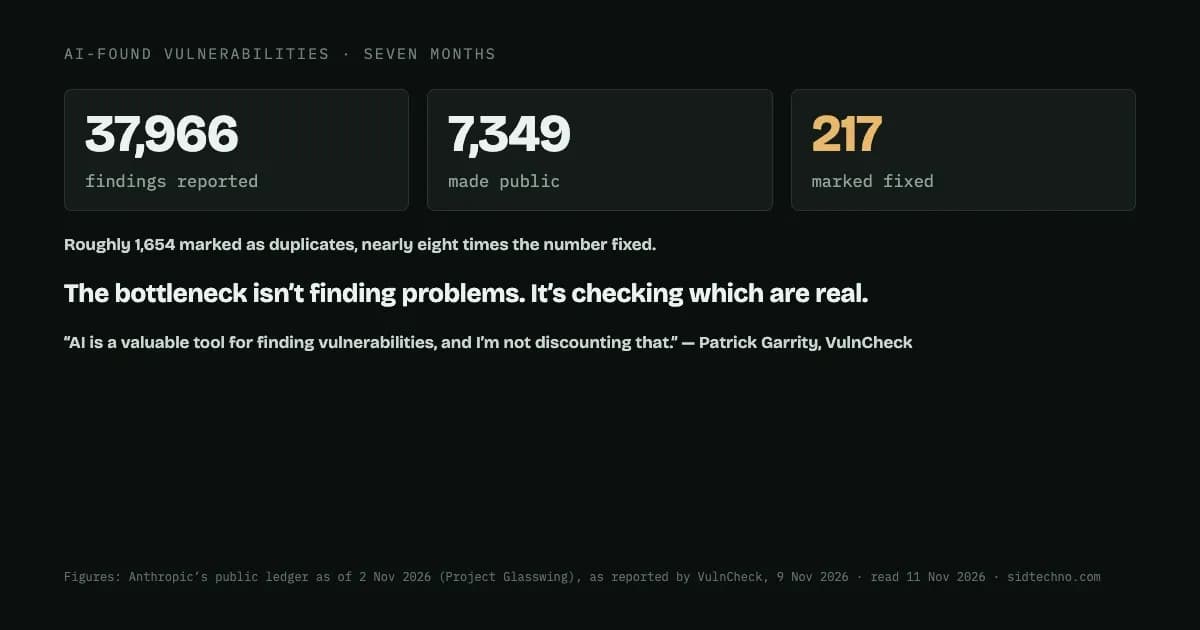
On 9 November 2026 VulnCheck published a seven-month update on Project Glasswing, Anthropic's effort to find vulnerabilities in open-source software with AI. The headline numbers are stark, but the most useful thing in the post isn't a verdict on one project. It's a measurement of where this kind of AI work can get stuck: not finding problems, but deciding which ones are real.
Two things to keep in mind. VulnCheck sells vulnerability intelligence, and the author, Patrick Garrity, has been tracking Glasswing critically since shortly after it launched. And he says plainly where he stands on the technology: "AI is a valuable tool for finding vulnerabilities, and I'm not discounting that."
The numbers
Most of the figures come from Anthropic's own public disclosure ledger, as of its 2 November update, as read by VulnCheck:
"Of Anthropic's 37,966 reported findings, only 7,349 (19.4%) have been made public and just 217 have been marked fixed."
VulnCheck adds: "Roughly 1,654 findings (4.4%) have been marked as duplicates, nearly eight times the number fixed, and another 419 have been withdrawn." And on the trend: "Since September, Anthropic has added nearly 12,000 findings while recording just 15 additional fixes, widening the gap between discovery and remediation."
Separately, from its own tracking of CVE records: "Seven months into Project Glasswing, VulnCheck has tracked 442 CVEs attributable to Anthropic, roughly 0.5% of all CVEs published this year, with only two identified as exploited in the wild."
The ledger also shows a claimed true positive rate that has risen to 94.2%. VulnCheck questions that figure, "raising questions about how it accounts for duplicates and withdrawn findings."
Where the work went
The post's most important point is about triage, and Anthropic has said much the same thing itself. VulnCheck quotes Anthropic's October announcement of a self-service scanner, which said Anthropic remains "bottlenecked on our human capacity to validate these findings." With that scanner, maintainers request a scan and check the results themselves, and Anthropic is upfront that the reports are "fully model-generated, without human review or triage" and that "it is possible reports will be incorrect or invalid."
That's a disclosed design choice, not a hidden one. But it means, as VulnCheck puts it, "the triage bottleneck didn't go away. It moved to the maintainers."
The post gives one maintainer's numbers. curl received a batch of reports from Anthropic, and "Of the 34 reports published so far, 19 have been marked as not a vulnerability, 6 have been confirmed as low severity, and 9 are still awaiting assessment." That's one project and an early count, so don't read it as a rate for the whole programme. But it shows what checking machine-generated reports costs the people who receive them.
The lesson for any AI pipeline
This isn't evidence that AI can't find vulnerabilities, and the author doesn't claim that. It's a measured gap between discovery and remediation, and it has a shape that will look familiar to anyone who has put a model to work on a codebase.
- Generation is cheap. Checking isn't. A model can produce findings, tests, review comments or refactors far faster than a person can confirm them. If you scale the first without the second, you build a queue.
- Duplicates are a cost too. VulnCheck's explanation for the jump in duplicates is that "the longer findings sit, the more likely someone else finds and fixes them first." Work that waits can lose its value.
- Measure outcomes, not output. Count what was fixed, merged or confirmed, not what was generated. A rising count of findings tells you little on its own.
- Decide who does the triage before you switch it on. If no one owns validating what the model produces, the cost lands on whoever receives it.
We've written before about how Cloudflare fences in its security AI. This is a related idea from the other side: what a model finds still needs someone to decide what's true.
Source: Patrick Garrity, VulnCheck, "After 7-months, Glasswing Overwelms Maintainers with Underwhelming Findings" (published 9 November 2026; read 11 November 2026). Ledger figures are Anthropic's own, as of 2 November, as reported by VulnCheck. Quotes attributed to Anthropic are as quoted in VulnCheck's post. VulnCheck sells vulnerability intelligence products.