
On GitHub's daily trending page, read on the evening of 29 October 2026 (UTC), the repository on that page with the biggest daily gain in stars was not a new model, an agent framework or a database. It was Impeccable, which describes itself as "The design vocabulary for your coding agent." Its README says what it's for: "catch AI slop before it ships." GitHub showed it gaining 2,881 stars that day. Another design-skills collection for coding agents, elayadesign/ai-design-skills, was on the same board with 1,178.
Star counts measure attention, not use, and one day's board is a snapshot, not a trend. But the attention points at something worth taking seriously if you build software with AI help, or hire people who do.
The admission underneath
A tool that exists to make AI-built interfaces look less like AI-built interfaces only makes sense if they currently do. Impeccable's README is specific about the tells:
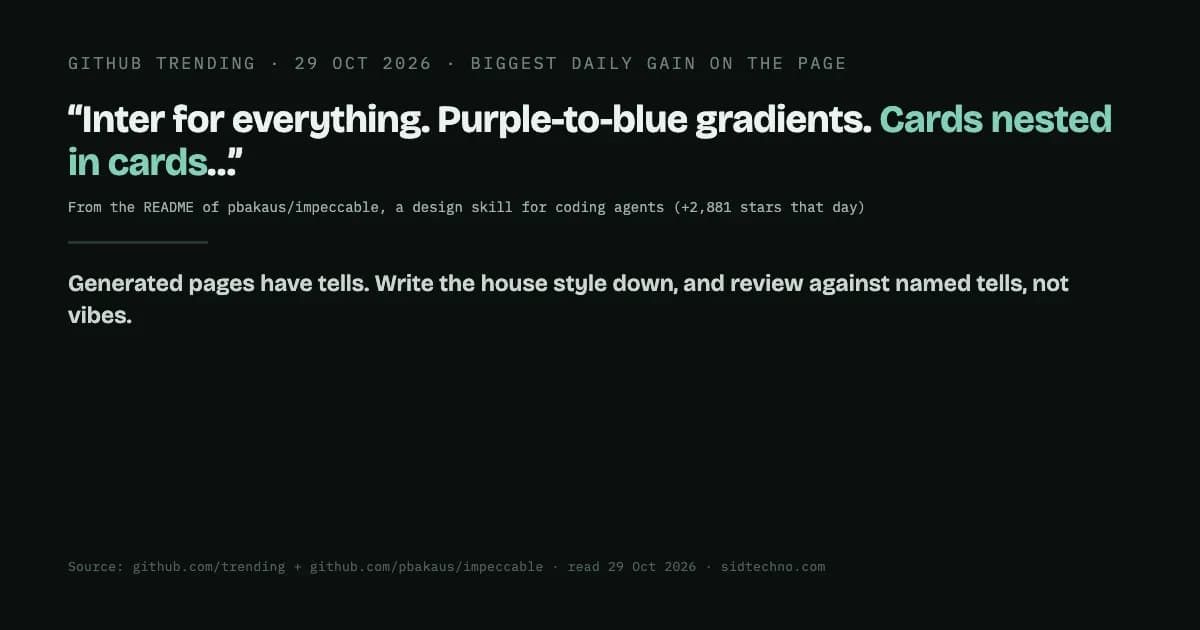
"Inter for everything. Purple-to-blue gradients. Cards nested in cards, gray text on colored backgrounds, a rounded-square icon tile above every heading. Ask an agent for a page with no other guidance and these show up again and again, across models and projects."
If you've looked at many recently launched landing pages, you'll recognise the list. The point isn't that any one of those choices is wrong. It's that when they all arrive together, by default, the page reads as unconsidered.
What these tools actually do
Going by its README, Impeccable doesn't try to make a model more capable. It gives the agent three things a design team would recognise:
- Vocabulary. Named moves like
polish,bolderandquieter, each backed by a written playbook, so "make it pop" becomes an instruction with a defined meaning. - Review. A
critiquecommand that scores a design against usability heuristics, and anauditthat checks accessibility, performance, theming and responsive behaviour, with findings ranked by severity. - A checklist. In its words, "62 deterministic rules" that flag the tells above and problems like cramped padding and skipped headings, with "No LLM, no API key."
It also asks the agent to write down what the product is and how its existing visual system works, in files that every later command reads. The ai-design-skills collection takes a similar approach: its design values live in one section of each skill file, to be edited for your own project.
What that means for anyone shipping AI-assisted work
Strip away the specific tool and the lesson is about process, not models:
- Write the house style down. Given no other guidance, agents keep reaching for the same defaults, as Impeccable's list shows. A short document covering who the product is for, the type, the colours and the spacing gives the agent something specific to aim at, and gives reviewers something to check against.
- Review against named tells, not vibes. "It looks a bit generic" is hard to act on. "Every section has an icon tile above the heading" is a fix someone can make.
- Keep the mechanical checks mechanical. Contrast, heading order and spacing rules don't need a model's opinion. Automate them, so human review time goes on the judgement calls.
- Change one thing at a time. Impeccable's README says it is strongest on interfaces that already exist: point it at one component and iterate. That's sound practice with or without the tool.
A clear brief, a written standard and a real review step don't come with the model. They're the part of the work that's still yours.
Sources: GitHub trending, daily (read 29 October 2026, 23:19 UTC; star figures are GitHub's displayed daily gains); READMEs of pbakaus/impeccable and elayadesign/ai-design-skills (read the same day).