
On 17 November 2026 the security firm Calif.io published details of a serious bug in OpenJDK, the open-source Java platform that many Java distributions are built from. In its words: "Today, we are disclosing Java4Shell (CVE-2026-114938), a memory-corruption vulnerability in OpenJDK's Base64 decoder." OpenJDK published its own security advisory the same day, listing CVE-2026-114938 among the fixes and recommending: "We recommend that you upgrade as soon as possible."
What makes this one different from most Java security news is a condition that's easy to skim past: whether a server is exposed depends on its processor as well as its Java version. Two servers running the same Java build can be in different positions.
Two conditions, both required
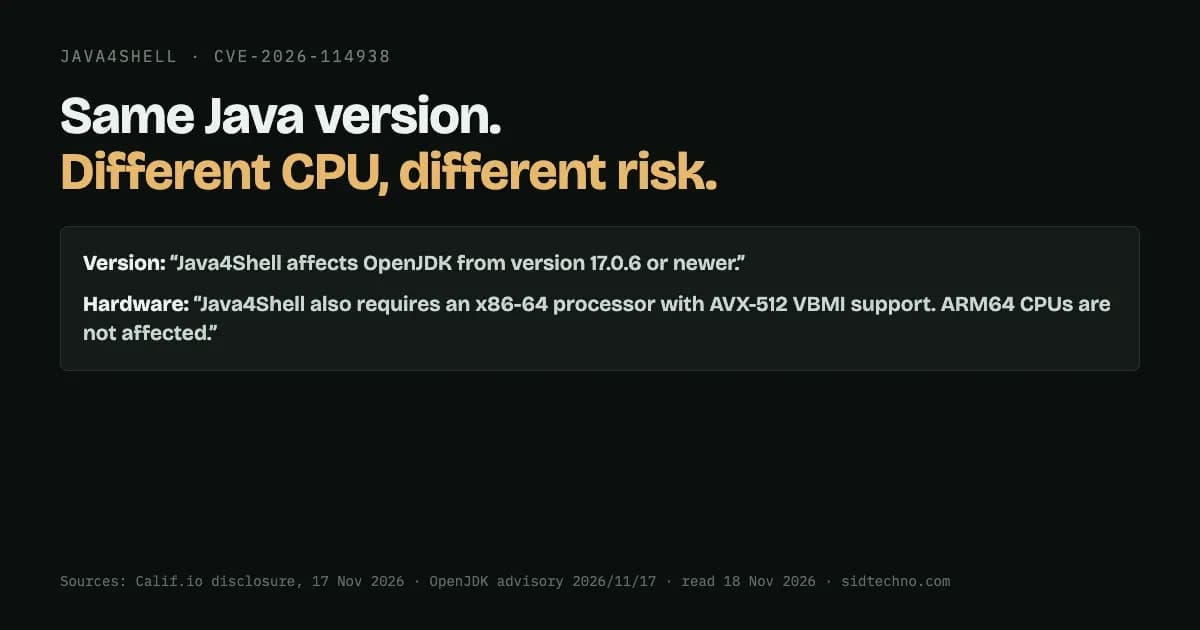
Calif sets out the version condition: "Java4Shell affects OpenJDK from version 17.0.6 or newer." And the hardware condition, in the same section: "Because the vulnerable code is hardware-specific, Java4Shell also requires an x86-64 processor with AVX-512 VBMI support. ARM64 CPUs are not affected."
Calif names these processor families as meeting the requirement: "Intel Xeon: Ice Lake, Sapphire Rapids, Emerald Rapids, Granite Rapids" and "AMD EPYC and Ryzen: Zen 4 or newer".
So a server is in scope, by Calif's account, only when both are true: Java at or above the affected version, and an x86-64 processor with AVX-512 VBMI. The same Java build on an ARM64 server, or on an x86-64 processor without that instruction set, isn't affected, according to Calif.
OpenJDK's advisory marks the CVE against Java 17, 21, 25 and 27 in its risk matrix and gives it a CVSS 3.1 score of 8.1. Calif gives its own score under a newer scoring version: "Under CVSS 4.0, this vulnerability scores 9.2 out of 10 (CRITICAL)." The two figures use different scoring systems, so they aren't directly comparable.
What Calif says the bug does
The cause, as Calif describes it, is a speed optimisation: "To decode Base64 faster, OpenJDK uses specialized x86-64 CPU instructions to process many bytes at once. We discovered a bug in that optimized machine-level code that lets malformed input overwrite neighboring memory." And the consequence: "With careful exploitation, the corruption can reveal sensitive memory, as Heartbleed did, or lead to remote code execution."
Calif says its testing showed remote code execution in a number of widely used Java applications in their default configurations, including Jenkins, Atlassian Jira and Confluence, Keycloak and Elasticsearch, some before login and some after. It adds: "The lists are non-exhaustive." And: "Ordinary features such as authentication and file uploads can expose the vulnerable Base64 decoder, extending the potential impact far beyond the products we tested."
It also describes a client-side case, from an exploit shared with it by another researcher: "A Java program that opens a TLS connection to a malicious server can be compromised, even if it exposes no service of its own." That matters because it means a Java program can be at risk even if it doesn't accept connections from the internet.
Two limits Calif states itself. The full attack chains aren't public yet: "The weaponized chains for individual products stay private until everyone has had a chance to upgrade." And each target needs its own work: "The exploit is not a universal point-and-shoot." Neither is a reason to wait. Calif has published the technique, and OpenJDK has published its fixes.
What to do
- Find your Java workloads at 17.0.6 or later on x86-64. Include applications that ship with their own Java runtime, not just the Java installed on the server. Containers count too: the processor that matters is the host's.
- Check the processor. Calif gives this command for Linux:
grep -m1 '^flags' /proc/cpuinfo | tr ' ' '\n' | grep -E '^(avx512f|avx512bw|avx512vbmi|bmi2)$'
And: "The output must include all four flags." - Update, using your own vendor's advisory. Calif lists many Java distributions as built from OpenJDK and therefore affected. Whether a fixed build is available for yours, and which version it is, is a question for that vendor's advisory, not for this post.
- If you can't update straight away, read the mitigation exactly as written. Calif: "You can also mitigate Java4Shell by starting OpenJDK with either:"
- "
-XX:-UseBASE64Intrinsicsto disable hardware-accelerated Base64 encoding and decoding, or" - "
-XX:UseAVX=2to disable AVX-512. Apply this flag only on x86-64 hosts. OpenJDK on ARM doesn't recognize it and will fail to start."
- "
- Don't forget outbound connections. Given Calif's client-side case, a Java program on affected hardware that only makes outgoing connections still needs updating.
How it was found
Calif's write-up says AI tools were part of the research. The researcher describes how the audit began: "Well, more precisely, I told Codex to look at those areas like any serious security researcher in 2026." The rest of the write-up describes a mix of the researcher's own work and AI-assisted steps, and we'll leave the details of that split to Calif's account.
Sources: Calif.io, "Java4Shell" (CVE-2026-114938, 17 November 2026; read 18 November 2026); OpenJDK, Vulnerability Advisory 2026/11/17 (read 18 November 2026). Affected versions, demonstrated products and the CVSS 4.0 score are Calif's; the CVSS 3.1 score and affected release lines are from OpenJDK's advisory.