
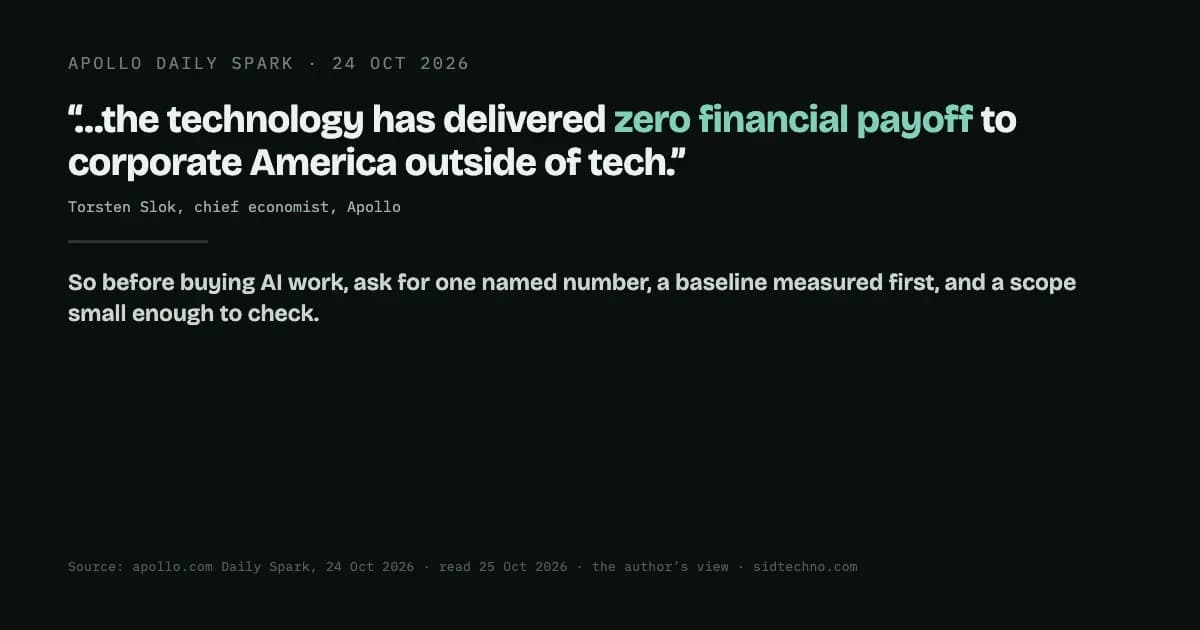
On 24 October 2026 Torsten Slok, chief economist at the investment firm Apollo, published a short note with a blunt headline: "No Signs of AI Payoff Outside the Tech Sector". His opening line is just as blunt: "Despite massive investments and widespread hype around artificial intelligence, the technology has delivered zero financial payoff to corporate America outside of tech."
If you are a business owner being pitched AI projects every week, that is worth reading carefully. It is also worth being clear about what it is and isn't.
What Slok actually says
The note is one economist's reading of market-wide data, published in Apollo's Daily Spark series, which carries a disclaimer that the views are the speaker's own and not necessarily Apollo's. It is not a survey of companies or a peer-reviewed study. His argument rests on five charts, drawn from Bloomberg, Macrobond, the Federal Reserve Bank of San Francisco, the US Bureau of Labor Statistics and Ramp, the corporate card company.
He compares the "Mag 7", the seven giant tech companies, with the "S&P 493", his shorthand for the rest of the S&P 500. In his words, revenue per worker "is rising for the Mag 7 but is flat for the S&P 493", profit margins "are rising for the Mag 7 but are flat for the S&P 493", and "there are still no signs of AI boosting productivity growth".
Then the part that matters most for anyone selling or buying AI work: "mainstream corporate America is pulling back and starting to view token spending not as a source of growth but as a cost center that weighs on margins."
His conclusion: "The bottom line is that the AI story will be decided in the S&P 493, not the Mag 7, and so far, there is no evidence that revenue growth or margins are improving outside the tech sector."
What it doesn't say
It does not say AI doesn't work. It says that, so far, the money spent on it outside the tech sector isn't showing up where finance teams look: revenue and margins, across whole companies and the whole index. A tool can save one team real hours and still be invisible at that level, especially when it was bought without anyone writing down what it was supposed to change.
Slok also gives a reason the gap may last. In his words, "in business, intelligence is mostly judgment. Judgment depends on context, and the answer varies with which human or which model you ask."
What a buyer should ask for instead
If AI spend is being reclassified as a cost centre, the useful response isn't to argue with the chart. It's to buy AI work the way you'd buy anything else you expect to earn its keep:
- One named number. Not "efficiency". Hours per week on a specific task, response time to a lead, error rate on a specific document, cost per order handled. If nobody can name the number, the project isn't ready.
- A baseline, measured before anything is built. Without the before, there is no after, and the project ends up judged on how impressive the demo looked.
- A scope small enough to measure. One workflow, one team, a few weeks. A company-wide "AI transformation" is exactly the kind of spend that disappears into the S&P 493 average.
- The running cost, written down. Model usage is billed per use and grows with volume. Know what a month costs at today's volume and at double it.
- A point where you stop. Agree up front what result would mean switching it off, and when you'll check.
None of that requires believing or disbelieving Slok's read of the economy. It just means that if AI is going to earn its place, it has to do it one measurable job at a time.
Source: Torsten Slok, Apollo Daily Spark, "No Signs of AI Payoff Outside the Tech Sector" (published 24 October 2026, read 25 October 2026). Chart values are not quoted here; see the original for the five charts.