
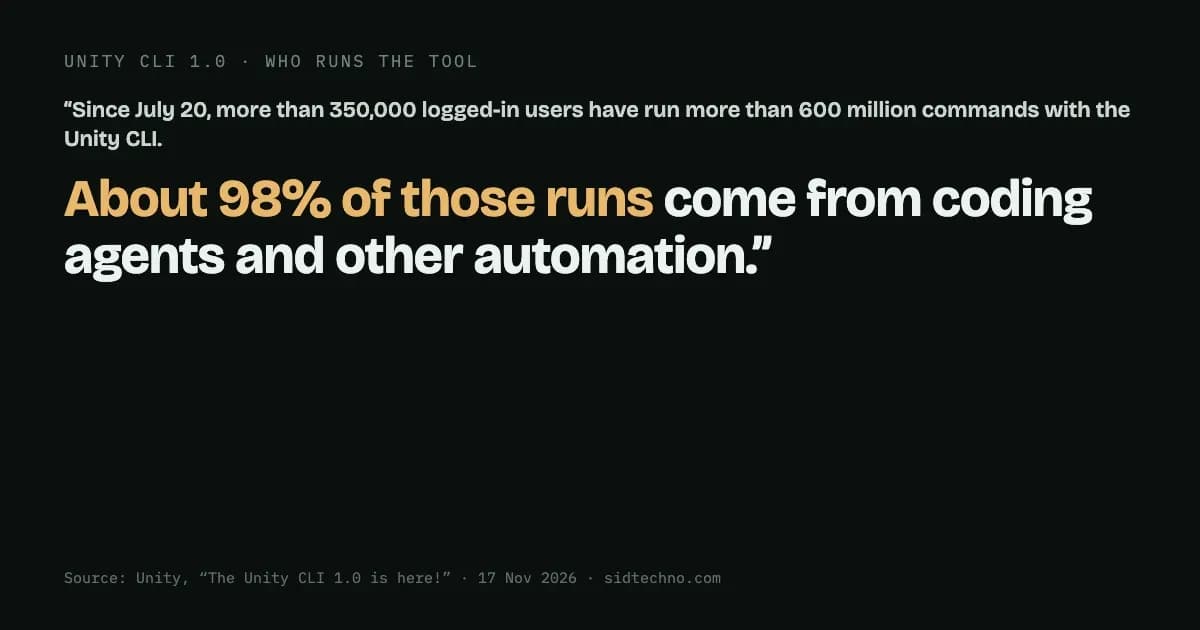
Unity has put a number on something many tool makers are only starting to notice. In a post published on 17 November 2026, announcing version 1.0 of the Unity CLI, the company reports: "Since July 20, more than 350,000 logged-in users have run more than 600 million commands with the Unity CLI. About 98% of those runs come from coding agents and other automation."
Read that carefully. The 98% is a share of runs, not of users or developers, and the two figures are floors ("more than"). Of the commands run through this tool, about 98% came from coding agents and other automation, which includes ordinary scripts and CI jobs. Unity's post is explicit that automation without AI counts too: "Agents without an official plugin still work in Unity through the CLI. So do scripts, test runners and CI jobs with no AI involved at all."
Even so, the direction is clear. For this tool, almost all of the commands are run by programs, not typed by people.
What changed in 1.0, and why it reads like a list for automation
The interesting part of the post is what Unity says it fixed, and where those fixes came from:
"Studios also sent us detailed reports: commands that said they succeeded when they hadn't, dialogs that blocked a remote session, scripts that broke when output changed shape. That feedback set the priorities for the releases that followed."
Each of those is a problem a person at a keyboard can work around and an unattended program can't. A person notices a popup. A script just waits. Unity's 1.0 changes, in its own words:
- Hidden dialogs: "The CLI can now see the dialog an Editor is waiting on and answer it, so a script or an agent doesn't hang on a popup nobody can see."
- Exit codes: "Clear exit codes tell a script when the Editor is busy, when a dialog is blocking it or when the network is down."
- Predictable output: "Every listing and stream now has the same JSON shape."
- Stability: "1.0 is also a commitment: commands, flags and output stay compatible across 1.x releases." And: "When something has to change, you’ll get a deprecation warning and time to update before anything is removed."
Unity also describes how an agent uses the tool: "The CLI is how an agent actually works with Unity: it opens the project, runs commands in the Editor, enters Play mode and reads the result."
The licence side
The post also covers where agents can run. Unity writes: "The Build Server license now covers agents and automation, not only builds: one license per instance lets you run agents on a headless Editor or in a container, on any computer." That's Unity's description of its own licence. If you use Unity, read the licence terms themselves rather than relying on a summary, including this one.
One more item is announced but not yet available: "Coming soon: the Linux containerized Editor, a supported headless Unity Editor in a Linux container, built for CI, build machines and agents."
What this means if you build or buy software
You don't need to use Unity for this to matter. If a large vendor finds that almost all runs of its command-line tool come from agents and automation, it's worth asking how much of the use of your own tools already comes from programs rather than people. A few practical points follow from Unity's own list of fixes:
- If you build tools or APIs, design for a user that can't see the screen. No prompts that block, clear exit codes, the same output shape every time, and success that means success.
- Treat output as a contract. If scripts or agents read your output, changing its shape breaks them. Version it, and warn before removing anything.
- A false "success" is the worst bug for automation. A person might notice. An agent will carry on as if it worked.
- If you buy tools, check how their licences treat automated use. Running agents or CI against a tool may be covered, may need a different licence, or may not be addressed at all. Ask before you build on it.
Source: Unity, "The Unity CLI 1.0 is here!" (Christopher Addison, 17 November 2026; read 17 November 2026). The usage figures are Unity's own and cover runs since July 20, as the post states.