
In a report dated 27 November 2026, InfoHawk reported that “A card-skimming script was planted on the online stores of Lascana, Samsonite, American Tourister, Revolve and FWRD in the week before Black Friday.” It adds: “After our reports to affected companies, all have had the script removed (on November 24th or 25th) ahead of Black Friday.”
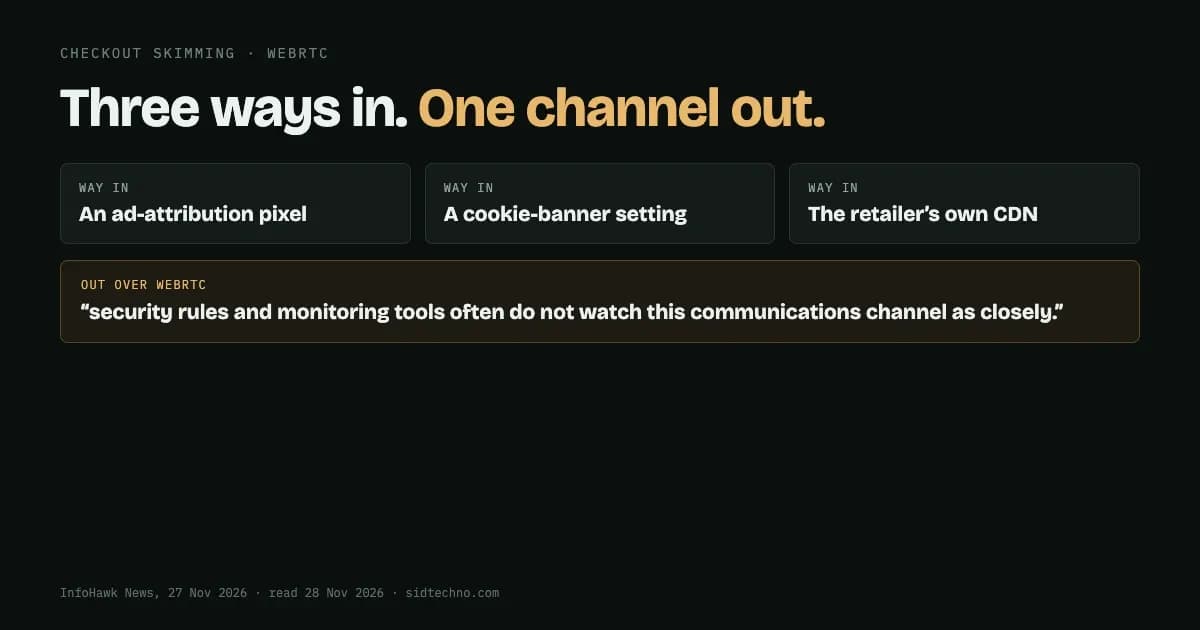
Two things make this one worth a closer look than the usual skimming story. The script didn’t get in the same way on every site. And once it was on the page, it used a channel that, in InfoHawk’s words, security rules and monitoring tools often do not watch as closely.
What is known, and what isn’t
Start with the limit, because it matters: “Across all of these sites, we do not know how many, if any, shopper details or payment credentials may have been captured.” InfoHawk says it saw the script working on one site: “We observed it in action on one of the five websites: Lascana, where it sent our test card's details to a 3rd party.” That was InfoHawk’s own test card. Nobody has published a count of affected shoppers, and we won’t estimate one.
Revolve, which runs Revolve and FWRD, gave InfoHawk this statement:
“On November 25, InfoHawk notified our team of a potential security issue impacting mobile and tablet versions of our websites which we resolved the same day. We appreciate the outreach, and are actively investigating the issue to determine any potential impact.”
InfoHawk also describes when the script acted: “It did this before the store checked the payment, so a card could be taken even if the order was declined or cancelled, and nothing would look wrong to the shopper.”
Three ways in
InfoHawk’s table lists a different delivery method depending on the site:
- Lascana: an altered Quorum marketing pixel. Quorum is an ad-attribution platform. InfoHawk reports: “Quorum confirmed the identified malicious code was removed from their pixel tracker, and they restored the clean marketing pixel as of November 24th at 21:09 UTC.”
- Samsonite and American Tourister: an edited Seers cookie-banner setting. Seers is a cookie consent platform. InfoHawk’s detail: “In the affected configs, the privacy-policy link field also held a hidden image, whose onerror event handler loaded the malicious code.” For both sites the table says: “Neither party replied to us, but the code was removed on November 24th at 14:25 UTC”.
- Revolve and FWRD: an altered file on Revolve’s own CDN. No outside vendor in this case: the file sat on the retailer’s own content delivery network.
These are three separate routes, not one compromised vendor. What links them, according to InfoHawk: “We saw the skimmer delivered in three different ways across five websites run by different companies, and all of them appear to rely on the same attacker infrastructure.”
In October we wrote about AdFection, where an ordinary ad carried code onto people’s screens. The lesson there was that third-party code on your pages is a supply-chain question. This case adds two things: a consent banner and a first-party file joined the ad pixel as ways in, and the target was the checkout page.
Why WebRTC
WebRTC is the browser technology behind video calls. InfoHawk explains why it was likely chosen:
“WebRTC lets a web page open its own channel to another party and pass data (e.g. audio/video packets) over it. It has likely been used (both to load the skimmer and to send the stolen card details out) because security rules and monitoring tools often do not watch this communications channel as closely.”
Its diagram of the attack puts it in terms of a site’s security policy: “Only step 4 is an ordinary web request, which a connect-src rule can block; steps 5 to 7 run over the WebRTC data channel, outside connect-src.” In other words, a rule that limits which servers a page may talk to can stop the setup step, but, in InfoHawk’s description, not the data channel once it is open.
It was also hard to see by testing the usual way: “This form of attack appears to target mobile devices, and we only saw the server enable the skimmer on checkout pages, so desktop checks and homepage scans would likely not see it.”
What to check if you run an online store
InfoHawk’s first recommendation for site owners: “On every page that takes payment, set a connect-src rule that lists only the hosts you use.” Its reasoning: “That blocks the two web requests the script needs before WebRTC opens. Without them the skimmer never arrives, whichever file was tampered with.” Its report also lists specific file names, hosts and strings to search for; if you run a store, read that section in full rather than relying on a summary.
Beyond that, these are the general questions the case raises:
- List every script that loads on your checkout page. That includes tag managers, ad and analytics pixels, and the cookie banner. InfoHawk notes that third-party code loaded this way “runs as an ordinary script with the same rights as the site's own code.”
- Ask whether each one needs to be there. InfoHawk’s view: “Every site should review which tracking pixels load on pages that take payment or sign-in details, who can change those files, and whether they need to be there at all.”
- Keep card entry out of reach of page scripts. InfoHawk again: “Card fields should sit in an isolated payment frame, and third-party tags should be kept off these pages entirely.”
- Treat vendor settings as code. At two of these stores the route in was a field in a cookie banner’s configuration. Know who can edit your third-party dashboards, not only who can change your source code.
- Watch your own files too. At Revolve and FWRD the altered file was on the retailer’s own CDN. Knowing when a file you serve has changed matters as much as reviewing what vendors serve.
- Test checkout the way your customers use it. In this case that meant a phone-sized touch screen at the payment step. InfoHawk’s note on its own indicators: “Desktop checks miss it.”
Source: InfoHawk News, “Credit card skimming scripts using WebRTC found on popular shopping sites” (dated 27 November 2026 on the page; the notifications it describes are dated 24 and 25 November; read 28 November 2026). Our earlier post: AdFection (15 October 2026).