
Written on 12 October 2026, about a change OVHcloud announced on 25 August 2026 and applied from 1 October 2026.
Here are two sentences from the same post by OVHcloud, published on 25 August 2026:
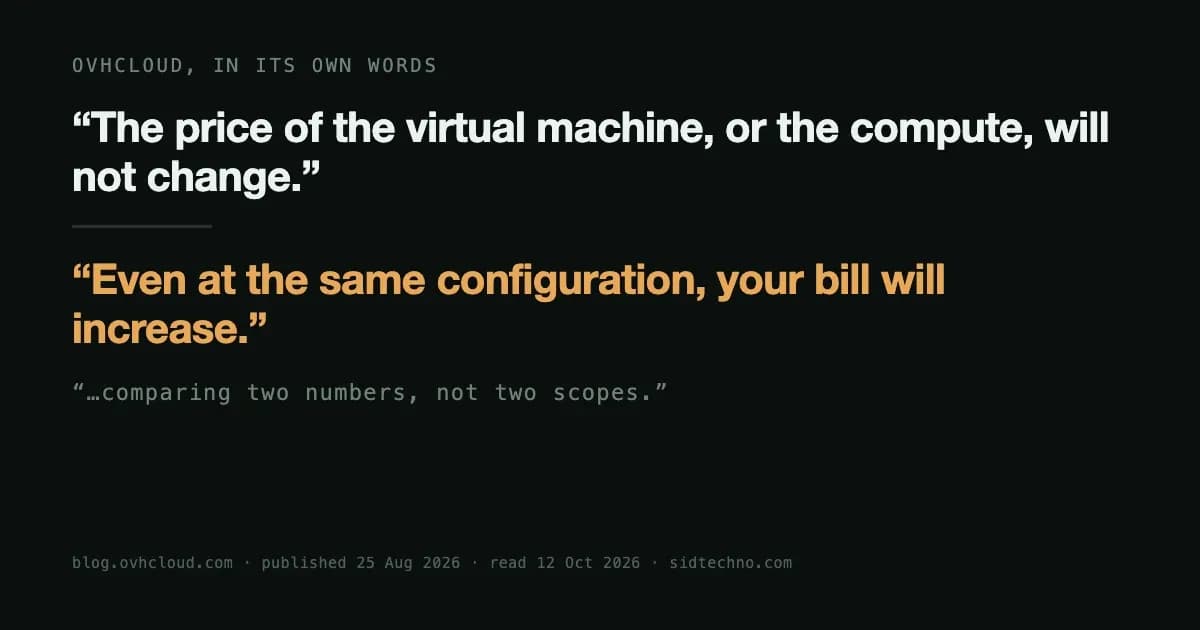
- "The price of the virtual machine, or the compute, will not change."
- "Even at the same configuration, your bill will increase."
They sit two sentences apart, and both are true. That is not a contradiction or a trick — it is what happens when something that used to be included in a price becomes a separate line on the invoice. It is worth understanding, because most invoice reviews check whether prices went up, and almost none check whether the meaning of "included" changed.
What OVHcloud changed
In OVHcloud's own words: "Our Public Cloud instances have historically included local storage and a public IPv4 address in the same price. From October 1st, 2026, these two resources will become separate billable lines."
The detail matters, so here it is precisely:
- Local storage is now billed separately on OVHcloud's Generation 3 instances (the B3, C3 and R3 families). The post is explicit that "On all previous ranges (B2, C2, R2 and earlier), it remains included."
- The public IPv4 address becomes an optional, separately billed item.
- The compute price — what you pay for the virtual machine itself — does not change.
OVHcloud gives its reasons. One is cost: "Buying memory costs us six times more today than it did a year ago, and storage is following the same trajectory." That is OVHcloud's statement about its own costs, not a figure we have checked. The other reason is about comparison, and it is the most useful sentence in the post: "When a customer puts two prices side by side, they are comparing two numbers, not two scopes."
To be fair to OVHcloud
This is a well-handled change, and it is worth saying so. OVHcloud announced it more than a month before it took effect, and it told customers plainly that their bill would rise rather than hiding it. It also says it chose this "rather than a general increase in the price of instances, because it makes each item more visible and actionable: for example, an IP address that serves no purpose can be released, or an oversized volume can be reduced." That is a genuine upside: a customer who doesn't need a public IP no longer pays for one.
The lesson here is not about OVHcloud. It is about how a bill can change shape.
"Our prices haven't changed" can be true — and still cost you more
A price rise is easy to spot: the same line costs more this month than last. Unbundling is harder to spot, because no existing line gets more expensive. Instead, new lines appear. If your check is "did any of our unit prices go up?", the answer is no — and the total is still higher.
There is a second, quieter effect. OVHcloud's post notes that for its Savings Plans, "The discount applies to the compute. Local storage and IPv4 addresses are billed at their actual price, excluding the discount, for the entire duration of your plan." In other words, a commitment discount can apply only to the part of the bill that didn't change. Whenever a provider unbundles, it is worth checking which lines a discount you signed up for actually covers.
Questions to ask before you sign a cloud quote
- What exactly is included in this price? Ask for the list, item by item — storage, IP addresses, bandwidth, backups, support. "Included" is only useful if you know what it covers.
- Which included items could become separate lines later, and with how much notice? A price list tells you today's prices; it rarely tells you how the scope of a price can change.
- Does any discount apply to every line, or only some? A percentage off "the price" may mean a percentage off one line.
- Are you comparing like with like? When two quotes differ, check whether you are comparing two prices or two different bundles. Two numbers are not two scopes.
How to read your own invoice for this
Don't just compare each line with last month. Compare the list of lines. A new line item you have not seen before — a storage class, an address charge, a "separately billed" resource — is the signal that something which used to be included no longer is. Then ask whether you actually need it: sometimes, as OVHcloud points out, the right response to a new line is to release the thing it bills for.
Want a second pair of eyes on a quote or a bill?
If you are about to sign a cloud or hosting quote, or your bill has gone up and you can't see why, get in touch. We can go through it line by line and tell you what is included, what isn't, and what you are actually paying for.
Source
- OVHcloud, "Public Cloud: the end of the all-in-one plan" — blog.ovhcloud.com/en/posts/public-cloud-pricing-model-update-2026/, by Octave Klaba, published 25 August 2026 (read 12 October 2026)