
On 2 November 2026 Anthropic filed an amended S-1 registration statement with the US Securities and Exchange Commission, the document a company files before listing its shares. The revenue is the obvious headline. If your business builds on an AI vendor's API, the more useful part is a few pages further on: what the vendor has committed to spend, and on what terms.
This is a reading of the filing itself, not of the coverage. Two cautions first. The 2026 figures are unaudited interim numbers, and this is a preliminary prospectus: in the filing's own words, "The information in this preliminary prospectus is not complete and may be changed." And none of this is investment advice. We're reading it as a buyer of the product, not of the shares.
The revenue side
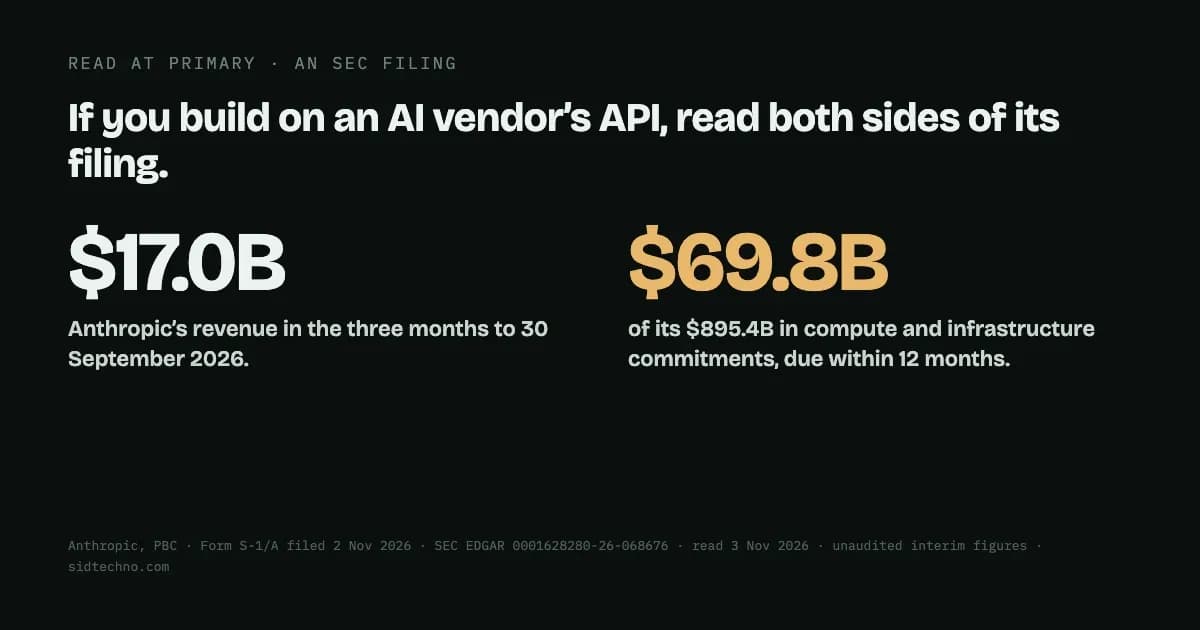
The growth is the headline, and the filing states it plainly: "our revenue increased from $197 million for the three months ended December 31, 2024 to $17.0 billion for the three months ended September 30, 2026." For the first nine months of 2026, revenue was $33.2 billion, which the filing puts at a year-over-year growth rate of 1,206%. For comparison, full-year revenue was $41 million in 2023, $386 million in 2024 and $4.6 billion in 2025.
Most of it is usage. The filing splits revenue into consumption-based and subscription-based. Under the consumption model, in its words, "customers pay for usage, which is metered in tokens and priced according to the model selected." For the nine months, consumption-based revenue was $26.3 billion, or 79% of the total, and subscription revenue $6.9 billion, or 21%.
On profit, be careful which line you read. The operating loss for the nine months was $1.3 billion, down from $5.2 billion a year earlier. The company's own adjusted measure, Adjusted Operating Income, was $4.1 billion, up from an Adjusted Operating Loss of $3.1 billion. The bottom-line net loss for the nine months is far larger, about $104.0 billion, but $94.3 billion of that is the change in the fair value of convertible notes and similar instruments. The filing explains that these are marked to market, so a higher company valuation shows up as a bigger expense. That line says more about the valuation than about the business.
The filing also warns against extrapolating: "We do not expect our revenue will continue to grow at comparable rates."
The obligation side
This is the part we'd point a client to. As of and after 30 September 2026, the filing says the company has "entered into purchase commitments and lease agreements, including short-term commitments, as well as leases not yet commenced, with an aggregate committed spend of approximately $895.4 billion, substantially all of which is related to compute and infrastructure."
That number needs its context. It isn't debt, and it isn't a balance-sheet liability. It's money the company has agreed to spend over many years, including on leases that haven't started yet. The filing gives the timing: "These commitments include approximately $447.5 billion expected to be incurred before December 31, 2030, and substantially all of the remainder is expected to be incurred between 2031 and 2045." And the near term: "Approximately $69.8 billion of these commitments are due in the 12 months following September 30, 2026."
What makes it worth reading is how the filing describes the terms. These are agreements that "involve minimum purchase commitments, take-or-pay provisions, and other terms that obligate us to pay for resources regardless of actual utilization. These commitments represent substantial fixed obligations."
Put the two sides together and you get the honest summary: the revenue is real and growing very fast, and the spending it has signed up for is very large, with long-term terms the filing itself calls substantial fixed obligations. The filing doesn't say how that turns out, and neither do we.
What this means if you build on an AI API
It's rare to get this much detail about a vendor you depend on. Usually a business building on a model provider's API has a pricing page and a terms of service, and has to guess at everything else. Here is what we'd take from it.
- Read the primary document, not the coverage. The figures above are on public pages anyone can read. Headlines will pick one number. The filing gives the context that changes what the number means, like "leases not yet commenced".
- Don't read pricing into it. The filing doesn't announce any price change, and nothing in it tells you what API prices will do. Anyone who says otherwise is guessing.
- Keep the model swappable. Whatever happens to any one vendor, an application that hard-codes a single model name is harder to move. We wrote about keeping the model name in configuration for exactly this reason.
- Know your own exposure. Track what you spend per provider, which features depend on which model, and how long it would take to switch. That's the same question the filing answers about its own suppliers, asked about yours.
- Revisit it when the filing changes. This is an amendment to a preliminary document. The numbers can move before it's final, so treat this as a snapshot dated 2 November 2026.
Source: Anthropic, PBC, Form S-1/A filed with the SEC on 2 November 2026 (accession 0001628280-26-068676), read on SEC EDGAR on 3 November 2026. Figures for 2026 are unaudited interim figures. This article is not investment advice.