
On 18 November we wrote about Java4Shell (CVE-2026-114938), the OpenJDK bug whose exposure depends on the server’s processor as well as its Java version. That post covered the update and the published mitigation. It didn’t answer a question many teams face with any serious bug: what protects a service in the days before the patch is actually deployed?
On 23 November 2026, OpenAI published an announcement aimed at exactly that gap. Its opening:
“OpenAI and Cisco are launching Shirudo, an open-source runtime that helps teams protect Linux systems while they roll out patches. In a controlled test, a Codex-generated shield blocked a Java4Shell exploit attempt against a running Elasticsearch service without requiring a restart.”
Those are OpenAI’s words, and the second sentence carries three qualifiers that belong together: a controlled test, a shield generated with OpenAI’s own Codex, and an exploit attempt. We haven’t tested Shirudo, and nothing below should be read as our result.
The problem it is aimed at
The announcement states the gap plainly:
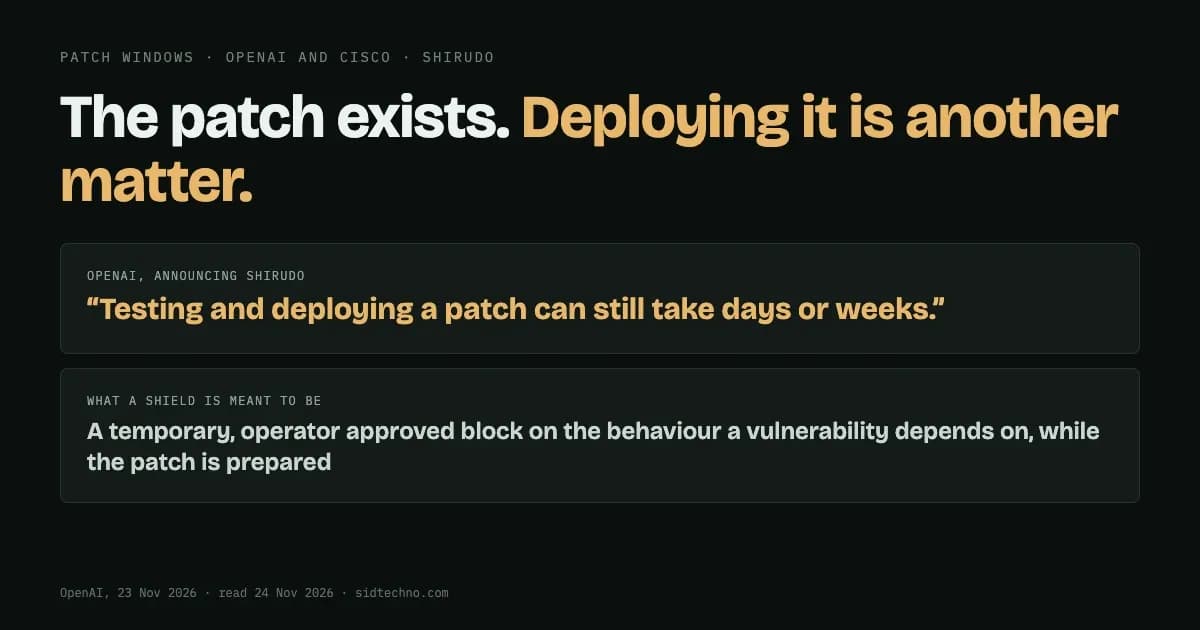
“Testing and deploying a patch can still take days or weeks. Protecting a service in the meantime can be challenging because an exploit and a legitimate request may rely on the same Linux operation. Blocking that operation entirely could take the service offline.”
OpenAI’s President, Greg Brockman, is quoted on the page making the same point: “We’re giving defenders better models and tools to find and fix vulnerabilities faster, but finding a bug today doesn’t mean you can patch every system tomorrow.”
Anyone who has run production systems will recognise this. A fix is published, and then it has to be tested against your own applications, scheduled and rolled out, and some services can’t simply be restarted when convenient.
What a “shield” is, in OpenAI’s description
“Teams can test whether a temporary safeguard, called a shield, blocks the behavior that exposes a vulnerability while allowing legitimate requests through. Once an operator approves the shield, it can be deployed while the service continues running.”
And the mechanism:
“Shirudo uses eBPF, a Linux technology that allows small programs to run at specific points inside the operating system. This makes it possible to observe suspicious activity and apply targeted security protections to running systems.”
In other words, the idea is a narrow, temporary block on the specific behaviour a vulnerability depends on, applied to a running Linux system, rather than switching off a whole feature or taking the service down. Think of it as a temporary mitigation, aimed more precisely.
The Java4Shell example, as OpenAI describes it
Further down the page, OpenAI gives more detail on its test:
“Using OpenAI's Codex, the team generated a shield that added an input check to Java's Base64 decoder and attached it directly to a running Elasticsearch process. When attempting to exploit the vulnerability, the shield rejected the malicious input, blocking the attack while Elasticsearch continued running.”
And it frames the example this way: “The Java4Shell vulnerability is another example illustrating how a targeted shield can protect a running application while a permanent patch is being prepared.”
Two things are worth keeping in mind. Elasticsearch was the application in OpenAI’s test; this isn’t an advisory about Elasticsearch, and nothing on the page changes the guidance for Java4Shell itself. Our Java4Shell post covers which servers are in scope, the vendor update and the published mitigation. And by OpenAI’s own framing, a shield is something to use “while a permanent patch is being prepared”, not instead of one.
Controls OpenAI says are built in
An automatically generated change to a running production system raises an obvious question: who decides it goes live? The announcement describes several controls. Among the capabilities it lists:
- “Security teams can monitor how a proposed shield would affect applications before enforcing it.”
- “Security teams control what gets deployed.”
- “Shields are cryptographically signed and verified before loading.”
- “Shirudo uses a Trusted Platform Module (TPM) to support a verifiable record of protections being loaded or removed.”
Note the wording that introduces that list: “OpenAI and Cisco are designing Shirudo around four core capabilities:” The page presents these as what the project is being designed around, and it calls Shirudo “a first step”: “Shirudo is a first step toward infrastructure that can adapt to emerging threats while remaining reliable.”
Open source, with a stated aim
The page links the code on GitHub and says: “Shirudo is licensed under BSD 2-Clause, with its BPF programs dual-licensed under BSD and GPL.” It also states where the project wants to go:
“Our goal is to make tested shields available alongside vulnerability disclosures, giving operators a way to evaluate and deploy temporary protections while preparing permanent patches.”
If that happens, a vulnerability disclosure could come with a tested temporary protection alongside the patch. As announced on 23 November, that’s a goal, not a description of what exists today.
What this means for your team now
- Patching is still the fix. Nothing in the announcement changes that, and OpenAI frames shields as cover while a patch is prepared.
- For Java4Shell specifically, follow your Java vendor’s advisory and the scoping in our Java4Shell post. A shield from a new project isn’t a substitute for that.
- If long patch windows are a real problem for you, this is a project to watch and to try outside production first. The announcement points to a VM quickstart and to the code on GitHub.
- Treat any shield as a production change. By OpenAI’s description, an operator approves a shield before it is deployed. That approval step deserves the same testing and review as any other change to a live system.
- It is built for Linux. The announcement describes a runtime to “protect Linux systems”, built on eBPF.
Source: OpenAI, “OpenAI and Cisco introduce Shirudo”, published 23 November 2026, read 24 November 2026. All quotes are from that page. The controlled-test result is OpenAI’s; we have not reproduced it. Java4Shell details are in our 18 November post, sourced from Calif.io and OpenJDK.